
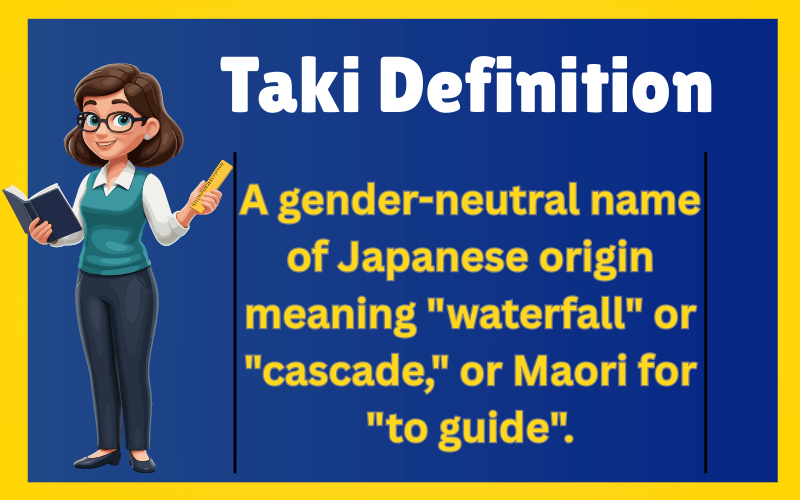
The term “taki” is a deceptively simple word that carries a wealth of meanings across cultures, languages, and contexts. From its roots in ancient languages to its modern interpretations in popular culture, “taki” embodies diversity in etymology and application. This comprehensive article delves into the depths of “taki,” exploring its definitions, historical evolution, linguistic variations, origins, associated myths, factual insights, and biographical connections. Spanning various sections with tables for clarity, this piece aims to provide an exhaustive overview, drawing from global perspectives. Whether viewed as a linguistic artifact, a personal name, or a cultural symbol, “taki” reveals layers of human expression and creativity. By the end, readers will appreciate its richness, complemented by frequently asked questions and a thoughtful conclusion.
Related Post: PFP Meaning In Text: Uses, Myths, History, Facts, Info Tables
Core Definition of “Taki”
At its most basic, “taki” is a polysemous term, meaning it has multiple related or unrelated definitions depending on the context. In linguistic terms, it often functions as a pronoun, adjective, or noun in various languages, signifying concepts like “such,” “so that,” or specific objects like tools or natural features. For instance, in Polish, “taki” primarily means “such” or “like that,” used to describe similarity or type. In Japanese, “taki” (written as 滝) translates to “waterfall,” evoking images of cascading water and natural power. This duality highlights “taki” as a bridge between everyday language and poetic symbolism.
Beyond linguistics, “taki” extends to proper nouns, such as names of people, places, or even brands. It appears in pidgin languages like Taki-Taki (an English-based creole from Suriname, meaning “talk-talk” or conversational speech). In slang or modern usage, “taki” can imply excitement, as in the made-up word from the song “Taki Taki,” representing an irresistible urge to dance or a “little demon” of fun. These definitions underscore “taki”‘s adaptability, making it a term that evolves with cultural shifts.
Meanings in All Languages: A Comprehensive Table
“Taki” manifests differently across global languages, often reflecting local environments, social norms, or historical influences. Below is a table summarizing key meanings from various languages, based on etymological and dictionary sources. This table categorizes by language family or region for ease of reference.
| Language/Region | Primary Meaning | Secondary/Alternative Meanings | Usage Example |
| Polish (Slavic) | Such; like that | Following; intensifying descriptor (e.g., “so handsome”) | “On jest taki przystojny” (He is so handsome). |
| Hindi (Indo-Aryan) | So that; in order that | Conjunction for purpose | “Tāki main jaa sakoon” (So that I can go). |
| Kannada (Dravidian) | Chisel; tool for cutting stone/metal | Motion picture with sound (talking picture); to weaken courage | “Ṭāki hari” (To lose intensity or confidence). |
| Maori (Austronesian) | To tow; entice; challenge; lead | To recite a speech; bring along; one by one | “Taki te waiata” (Lead the song). |
| Japanese (Japonic) | Waterfall; cascade | Height/stature; measure (alternative kanji) | “Taki o miru” (To see the waterfall). |
| Silesian/Czech (Slavic) | Such; of that kind | Similar to Polish usage | “Taki jak on” (Such as him). |
| Toki Pona (Constructed) | Sticky; magnetic; to bond/attach | Attract; clip | Used in minimalist sentences for adhesion concepts. |
| Surinamese Creole (English-based) | Talk-talk (pidgin language name) | Conversational pidgin; also called Ningre-Tongo | Refers to the language itself. |
| Greek (Indo-European) | Such; similar; of the same kind | Used for comparison; slang for “crazy” in some contexts | “Taki einai” (Such is). |
| Hausa (Afro-Asiatic) | Manure; fertilizer | To fertilize | Agricultural context. |
| Igbo (Niger-Congo) | To fertilize | Related to growth or enrichment | “Taki the soil.” |
| Russian (Slavic) | Finally; emphasizing long-awaited event | “Tak i” (And so; but) | “Tak i sluchilos'” (And so it happened). |
| Spanish Slang (from songs) | Made-up: illness to dance/sing; little demon | Excitement; fun (contextual) | From “Taki Taki” song: irresistible vibe. |
| Urban Slang (Global) | Various: shit (Guam); spicy snack reference | Crazy; addictive | Informal, regional usages. |
This table illustrates “taki”‘s global footprint, with over 15 distinct linguistic interpretations. Note that spellings may vary (e.g., “ṭāki” in Kannada), and meanings can shift with dialects.
Origins and Etymology
The origins of “taki” trace back to Proto-Indo-European roots, particularly in Slavic languages where it derives from “taˀkos” or “takъ,” meaning “such” or “that kind.” In Polish, it was first attested in 1360, evolving from Old Polish to modern usage as a demonstrative pronoun. In Hindi, “tāki” stems from Sanskrit influences, functioning as a conjunctive particle for expressing intent.
In Japanese, “taki” (滝) originates from ancient kanji representing natural phenomena, symbolizing fluidity and power since the Asuka period (around 600 AD). Maori “taki” likely has Polynesian roots, linked to actions of leading or challenging, reflecting oral traditions in Pacific cultures.
For the pidgin “Taki-Taki,” its etymology is reductive: from English “talk,” doubled for emphasis, emerging in Suriname during colonial times (17th-18th centuries) among enslaved Africans and indigenous peoples. Modern slang origins, like in the 2018 song “Taki Taki,” are invented for rhythmic effect, blending Spanish, English, and creative wordplay without historical roots.
As a name, “Taki” often derives from Japanese “waterfall” or Greek diminutives like “Panagiotis” (meaning “all-holy”), showing cross-cultural adoption.
Related Post: Roll Call Or Role Call, All Facts, Myths, History, Future
Historical Evolution
Historically, “taki” has evolved from ancient descriptors to modern identifiers. In medieval Slavic texts (14th century), it appeared in chronicles for comparative purposes. By the 16th century, in Japan, “taki” named geographical features, influencing poetry and art during the Edo period.
The 20th century saw “taki” globalize: Taki-Taki pidgin formalized in Suriname post-slavery (1863), becoming Sranan Tongo. In 1971, graffiti artist TAKI 183 (Demetrius) popularized “taki” in New York, marking urban culture’s rise.
In snacks, “Takis” (note the plural) originated in Mexico in 1999 by Barcel (under Grupo Bimbo), inspired by taquitos. Introduced to the U.S. in 2004-2006, it exploded in popularity by the 2010s, symbolizing bold flavors in global markets.
Biographically, historical figures like Princess Taki (died 751 AD, Japan) represent early name usage, while modern ones like Mohamed Taki Abdoulkarim (1936-1998, Comoros president) show political ties.
Taki as a Name: Biographies and Wiki-Style Overview
“Taki” serves as both a given name and surname, often unisex. Below is a wiki-style summary of notable individuals, akin to a biographical encyclopedia.
People Named Taki
- Iwao Taki (1901–1984): Japanese malacologist specializing in shellfish studies. Contributed to marine biology classifications.
- Kōji Taki (1928–2011): Japanese critic and philosopher, known for postmodern analyses in art and society.
- Kumari Taki (born 1999): Kenyan middle-distance runner, competing in international athletics.
- Makoto Taki (born 1938): Japanese politician, served in government roles focusing on economic policy.
- Masami Taki (born 1972): Japanese football manager, coached teams in J-League.
- Michiyo Taki (fl. 1927): Japanese football player, early pioneer in women’s sports.
- Mohamed Taki (born 1971): Moroccan runner, specialized in long-distance events.
- Mohamed Taki Abdoulkarim (1936–1998): Comoros president, led political reforms.
- Natsuki Taki (born 1993): Japanese announcer, media personality.
- Pāora Taki (died 1897): New Zealand tribal leader and warrior of Ngāi Te Rakiāmoa hapū.
- Pierre Taki (born 1967): Japanese singer and actor, member of Denki Groove.
- Princess Taki (died 751): Japanese princess during Asuka period, historical figure in imperial lineage.
- Rentarō Taki (1879-1903): Japanese pianist and composer, known for romantic works.
- Rion Taki (born 1992): Japanese football player.
- Tage Taki (born 1962): Indian politician from Arunachal Pradesh.
- Thozamile Taki (born 1971): South African serial killer, infamous case.
- Yukari Taki (born 1987): Japanese actress and tarento.
- Yūta Taki (born 1999): Japanese football player.
- Taki Theodoracopulos (born 1936): Greek journalist, founded Taki’s Magazine.
- TAKI 183 (born 1953-1954): American graffiti artist, “father of graffiti.”
- Taki Inoue (born 1963): Japanese racing driver.
- Taki Saito (born 2000): Filipina actress and singer in Faky.
- Ta-ki (born 2005): Japanese K-pop contestant in I-Land, member of &Team.
Related Post: Camisole Meaning Slang: Uses, History, Tables, Facts, Myths
Fictional Characters
- Taki (Soulcalibur): Female ninja in fighting games, demon hunter since 1995.
- Taki Matsuya: Marvel Comics mutant with tech abilities.
- Taki Reizen: From manga Maiden Rose.
Places
- Taki, India: Town in West Bengal.
- Taki, Iran: Village in Gilan.
- Taki, Mie: Town in Japan.
This section acts as a bio/wiki hub, highlighting “taki”‘s human element.
Origins of Related Concepts
Beyond the word, “taki” ties to broader origins. The snack Takis originated in Mexico (1999), created by Morgan Sanchez at Barcel, drawing from taquito shapes. The language Taki-Taki originated in 17th-century Suriname plantations. Myths link “taki” to Maori challenges (wero), originating in tribal rituals.
Related Post: WYLL Meaning, History, Myths, Facts, All Mystery 2026
Myths and Legends Associated with “Taki”
Myths surrounding “taki” blend folklore and urban legends:
- Maori Myth: Taki as a challenge spirit; legend says invoking “taki” summons ancestral warriors for protection.
- Japanese Folklore: Waterfalls (taki) house kami (spirits); myth of a dragon turning into a taki for eternal flow.
- Snack Myths: Urban tales claim eating too many Takis erodes stomach lining (busted: spice irritates but not corrosively). Another myth: Takis cause gallbladder issues (unrelated; anecdotal).
- Song Legend: “Taki Taki” mythically means ancient Sumerian deities (Anunnakis referenced), but it’s invented.
- Graffiti Myth: TAKI 183 started graffiti alone (busted: predates him, but he popularized tagging).
These myths add mystique, often debunked by facts.
Facts About “Taki”
Here are verified facts:
- “Taki” in Toki Pona was coined in 2020 from Korean “tak” (magnet sound).
- Takis snacks: Invented 1999 in Mexico; U.S. debut 2006; flavors like Fuego contain MSG forms.
- Nutrition Fact: 28g Takis serving = 150 calories, 8g fat, 200mg sodium.
- Historical Fact: Princess Taki’s eye became star Taki-ara in myth.
- Language Fact: Taki-Taki (Sranan Tongo) spoken by 500,000+ in Suriname.
- Cultural Fact: “Taki” as name ranks low in popularity but symbolizes grace.
- Snack Fact: Takis inspired by taquitos; no standalone seasoning sold.
- Myth-Busting Fact: No evidence Takis harm immune systems directly; artificial dyes/TBHQ concerns are general.
Table of Fun Facts:
| Fact Category | Detail |
| Linguistic | Appears in over 10 languages with distinct meanings. |
| Cultural | Symbolizes waterfalls in Japanese art. |
| Modern | Song “Taki Taki” (2018) has 2B+ views. |
| Biographical | Over 20 notable people named Taki. |
| Snack-Related | Expanded to nuts in 2020s. |
Related Post: Orgo Meaning, Uses, Myths, Facts And Ultimate knowledge
FAQs
What is the most common meaning of “taki”?
In everyday use, it often means “such” in Slavic languages or “waterfall” in Japanese, but varies by context.
Is “taki” related to the snack Takis?
Yes, indirectly; Takis is a brand name inspired by taquitos, but the word “taki” predates it in languages.
Can “taki” be used as a name?
Absolutely; it’s unisex, meaning “waterfall” in Japanese or a diminutive in Greek, with many famous bearers.
Conclusion
“Taki” transcends a mere word, embodying linguistic diversity, cultural depth, and historical resonance. From its Proto-Indo-European origins to modern slang and names, it reflects humanity’s knack for adaptation. Whether evoking a majestic waterfall, a spicy snack, or a pioneering artist, “taki” invites exploration. This article, while extensive, scratches the surface—encouraging further curiosity into its endless facets. In a world of evolving language, “taki” reminds us that meanings are as fluid as the cascades it often represents.
View Also: PUNSCRACK.COM

